We are engaged in the development of quantum materials that exhibit novel electronic and magnetic phases and properties, and in uncovering their innovative functions. Our particular interest lies in the entropic and thermal functionalities of quantum materials. In addition, we keep exploring materials with exotic electronic properties, such as unconventional superconductivity and quantum spin liquids. Examples of our ongoing projects, along with some highlights so far, are presented below.
Ongoing Projects
Entropic Functions of Quantum Materials
Quantum materials often host large electronic entropy arising from their charge, spin, orbital, and lattice degrees of freedom. This entropy can be exploited for applications such as heat storage and solid-state cooling. We explore new quantum materials with exceptionally large electronic entropy and investigate ways to control it for functional use.
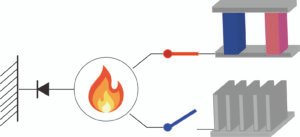
Thermal Control Using Quantum Materials
Development of New van der Waals Magnets
van der Waals magnets are layered magnetic materials in which the magnetic layers are bound by weak van der Waals forces. They have attracted considerable attention not only for their unique low-dimensional magnetism but also for their promising potential in device applications. Our research focuses on synthesizing novel van der Waals magnets with tailored magnetic and electronic functionalities, including enhanced magnetic ordering temperatures, unconventional magneto-thermal properties, and exotic magnetic excitations driven by strong spin–orbit coupling.
Exploration of Exotic Spin-Orbit-Entangled Electronic Phases
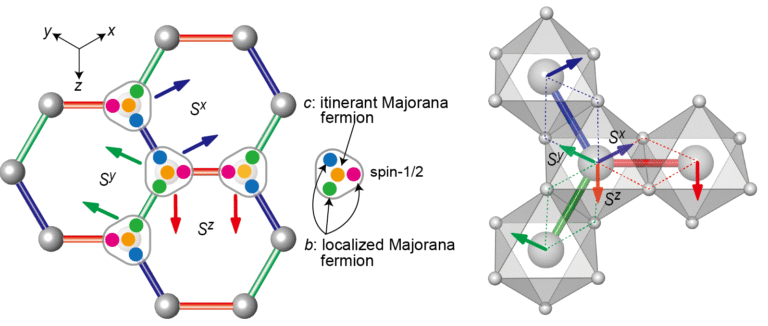
The interplay between moderate electron correlations and strong spin–orbit coupling in heavy transition-metal compounds has been shown to produce a variety of exotic phases, including spin–orbit Mott insulators, mutipolar ordering, and spin–orbit–induced semimetals. Our research aims to uncover further unconventional electronic states that remain hidden, such as topological spin liquid, superconductivity emerging near spin-liquid phases, and multipolar liquid states.
High-Entropy Quantum Materials
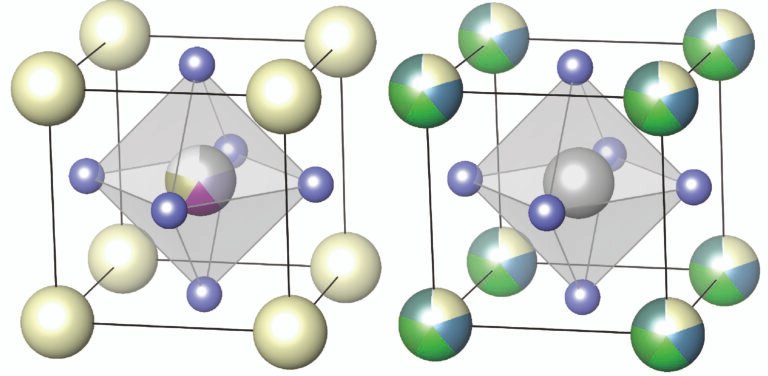
High-entropy oxides comprise multiple cations—typically more than five—sharing the same crystallographic site. The resulting large configurational entropy facilitates a fully random cation distribution, and this extreme chemical disorder has been shown to yield remarkable properties such as giant dielectric constants and exceptional ionic conductivity. By extending the high-entropy concept to quantum materials, we seek to develop advanced electronic and magnetic functionalities.
Highlights of our research so far
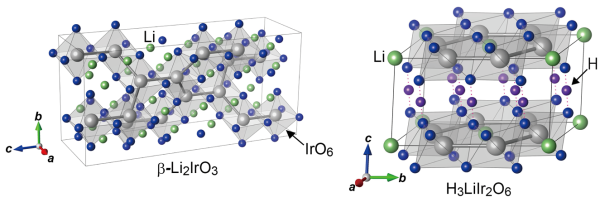
Candidate Materials for Kitaev spin liquid
[2] T. Takayama et al., Phys. Rev. B 99, 125127 (2019).
[3] K. Kitagawa, T. Takayama et al., Nature 554, 341 (2018).
[4] T. Takayama et al., npj Quantum Mater. 10, 7 (2025).
Spin-orbit physics in 4d/5d transition-metal compounds
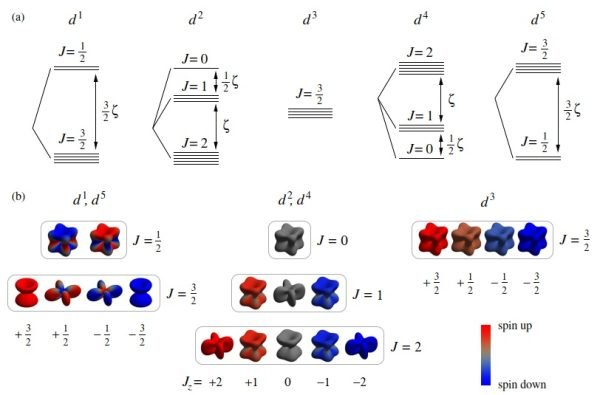
Traditionally, 3d transition-metal compounds with strong electron correlations have played a central role in realizing novel electronic states in correlated quantum materials, exemplified by high-Tc superconductivity, colossal magnetoresistance, and multiferroics. In contrast, 4d and 5d transition-metal compounds have been long regarded as weakly correlated and thus less exotic, and consequently received less attention. However, another key electronic parameter—spin–orbit coupling—becomes increasingly significant when moving from 3d to 4d and 5d systems. The interplay between moderate electron correlation and strong spin–orbit coupling has recently been revealed to give rise to a spin-orbit-entangled state and resultant unique electronic phases and phenomena [5], including spin–orbital liquids, Bose–Einstein condensation of magnetic excitons, and correlated topological semimetals.
Our research focuses on exploring such phases in 4d and 5d transition-metal compounds. Examples of our discoveries include multipolar order in 5d systems [6], competition between spin–orbital entanglement and orbital molecule formation [7,8], and the emergence of spin–orbit–driven semimetallic states [9-11].
[5] T. Takayama et al., J. Phys. Soc. Jpn. 90, 062001 (2021).
[6] H. Ishikawa et al., Phys. Rev. B 100, 045142 (2019).
[7] T. Takayama et al., Phys. Rev. Res. 4, 043079 (2022).
[8] A. Krajewska et al., Sci. Adv. 10, eadn3880 (2024).
[9] T. Takayama et al., Sci. Rep. 4, 6818 (2014).
[10] T.Takayama et al., J. Phys.: Condens. Matter 31, 074001 (2019).
[11] T. Takayama et al., Phys. Rev. Mater. 4, 075002 (2020).
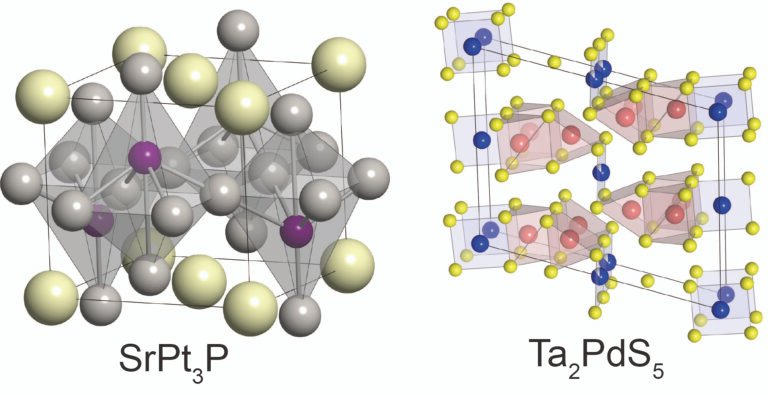
Discovery of new 4d/5d-based superconductors
[12] T. Takayama et al., Phys. Rev. Lett. 108, 237001 (2012).
[13] D. Hirai et al., Phys. Rev. B 85, 140509(R) (2012).
[14] Y. Lu et al., J. Phys. Soc. Jpn. 83, 023702 (2013).